
Bowls, Bobbins and Boxes: Craft Uses for Birch Panels
A small workshop does not need a container of timber to work with birch — it needs a few sheets, a sharp tool and a cutting plan that suits small parts. Dongstar lists the craft end of the species plainly: bowls, spools, bobbins, shuttles and dowels for turning, plus boxes, baskets, woodenware and cooperage. The timber behind them is Betula Alleghaniensis, heavy, hard and stiff, and the page recommends pre-drilling before any screw goes in.

Key takeaways
- The turning list runs to five items: bowls, spools, bobbins, shuttles and dowels.
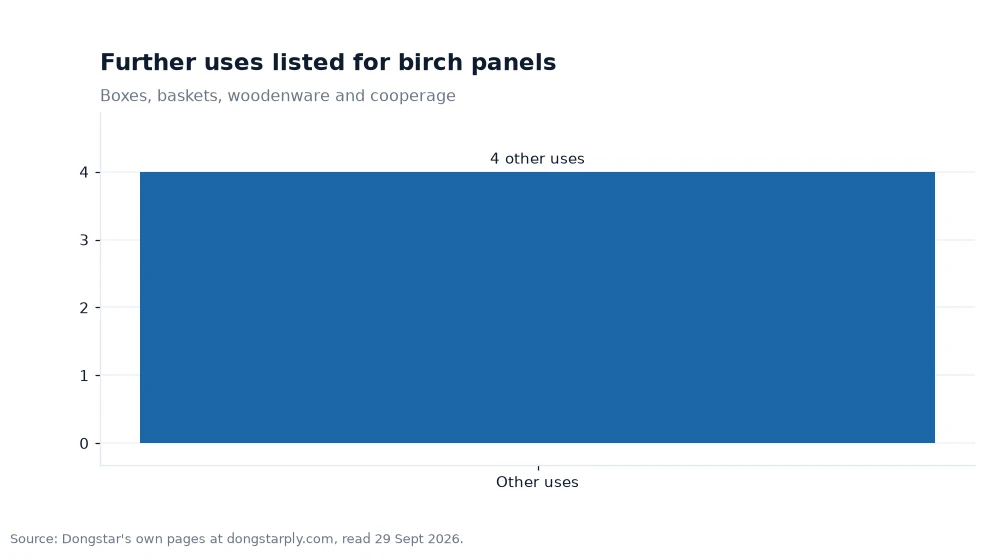
- Four further uses are named for the same timber — boxes, baskets, woodenware and cooperage.
- Sheet sizes are the 4 × 8 format at 12 mm, 18 mm and 24 mm, with 12 mm aimed at fine woodworking.
- Betula Alleghaniensis is a dense hardwood, so the page recommends pre-drilling for fixings.
Panel stock for work that reads as solid wood
A craft workshop usually reaches for sheet because it is flat, uniform and available in the thicknesses the job needs. That is exactly what birch panels offer: a straight-grained face over a layered core, sawn to 4 × 8 and sold in 12 mm, 18 mm and 24 mm. For a bowl blank, a bobbin run or a small box lid, the panel replaces a board that would otherwise need jointing, planing and seasoning before any shaping began.
The species is Betula Alleghaniensis, a hardwood that grows across Canada and the eastern United States. Its heartwood is reddish brown and its sapwood pale yellow, which is the contrast that shows up first on an unfinished edge and gives small objects a visible face and side rather than one flat tone. The timber itself is Canadian and American in origin; the panels are pressed and faced at Dongstar's plant in Linyi city, Shandong, China, which is where the sheet sizes and thicknesses in this article are published.
Bowls and bobbins: turning from panel stock
Five turned products are named for this material: bowls, spools, bobbins, shuttles and dowels. Turning rewards straight grain more than any other operation. A gouge travelling across the grain meets a surface that changes direction constantly, and each change is a chance for the tool to tear the fibres instead of cutting them. Straight grain takes that variability out of the pass.
Thickness decides how the blank is prepared. A 12 mm panel is thin for a deep bowl, so turners laminate two or three blanks face to face to build the height they need, which also lets them orient the grain deliberately. For spindles, spools and dowels the panel is cut into square sections first, then mounted between centres — a method that suits batch work where twenty identical pieces matter more than one large one.
Boxes, baskets, woodenware and cooperage
The second published list is shorter and more domestic: boxes, baskets, woodenware and cooperage. These are the objects that get handled, stacked, dropped and repaired — lidded boxes, woven basket bases, spoons and handles, kitchen woodenware, and the stave work behind small barrels and tubs.
What they share is exposure. Every one of them has an edge that will be seen and touched repeatedly, so an edge that chips or fuzzes after a season of use defeats the point of choosing a hardwood face. A dense timber takes a cleaner chamfer, holds a rounded profile, and keeps that profile longer. The same density makes hand tools work harder, which is the trade a small shop accepts knowingly when it buys this species.
Nesting small parts on a 1220 × 2440 mm sheet
Craft work lives or dies on the cutting plan. Because 1.22 m × 2.44 m comes to 2.98 m², a single sheet will hold a great many small parts — but only if they are laid out before the first cut rather than one at a time. Working from a drawn plan, with the grain direction marked on every piece, is what keeps a batch of fifty identical components identical.
The offcut pile deserves a plan too. Strips 70 mm or 80 mm wide are too narrow for a shelf and ideal for dowels and small turned blanks; short ends from a door panel become box sides and basket bases. A workshop that keeps narrow offcuts in labelled lengths instead of a general scrap bin rarely has to open a fresh sheet for a small job.
Finishing faces, edges and pilot holes
Three finishing rules do most of the work on a dense sheet. Cut with a sharp, fine-toothed blade to keep tear-out off the face. Sand the edges progressively rather than pressing hard in one pass, because a dense timber resists fast material removal. And pre-drill every fixing, as the page recommends, since a screw driven straight into dense hardwood can split a narrow piece or lift the face veneer at the edge.
For finishes, the deciding factor is use rather than fashion. Objects that meet food or hands want a finish that can be renewed by the owner with a cloth — a drying or hardening oil rather than a film finish that shows every scratch. Objects kept dry and decorative will take wax or lacquer happily. On faces that will be handled daily, a light oil refreshed once a year keeps the colour even and the surface smooth.
| Field | Published value |
|---|---|
| Turning uses | Spools, bobbins, shuttles, dowels, bowls |
| Other uses | Boxes, baskets, woodenware, cooperage |
| Sheet format | 4 × 8, in 12 mm, 18 mm and 24 mm |
| Species | Betula Alleghaniensis, from Canada and the eastern United States |
| Working note | Machines well; pre-drilling recommended on this dense timber |
Worked example: how many blanks a sheet will yield
Suppose a turner wants 90 mm square blanks for spools and dowels. Across a 1220 mm sheet width, 1220 ÷ 90 = 13 blanks per row with a little waste (example). Along the 2440 mm length, 2440 ÷ 90 = 27 rows (example). That is 13 × 27 = 351 blanks from one sheet before the kerf of the saw is counted, and a blade taking 3 mm per cut removes roughly 12 × 3 mm = 36 mm of the width and 26 × 3 mm = 78 mm of the length (example). Even allowing for that, a single sheet supplies blanks for several hundred small parts.
Put the same arithmetic against a bowl blank. A 200 mm circle from 40 mm of laminated 18 mm stock needs three layers glued face to face, since 2 × 18 mm = 36 mm and 3 × 18 mm = 54 mm (example). Across 1220 mm, 1220 ÷ 200 = 6 blanks per row; along 2440 mm, 2440 ÷ 200 = 12 rows (example). One sheet therefore supplies up to 72 bowl blanks at that diameter, which is why the material choice usually comes down to how the sheet is nested rather than how much of it is needed.
Frequently asked questions
Is panel stock suitable for turned work?
Yes, and the supplier names five turned products for it: spools, bobbins, shuttles, dowels and bowls. The straight grain and fine, uniform texture are what let a tool take a clean shaving, and thick blanks can be laminated from thinner sheets where a single panel is not deep enough.
What other craft work is listed for the timber?
Four uses: boxes, baskets, woodenware and cooperage. They are all objects with edges that get handled and seen, which is where a dense hardwood face earns its place over a softer one.
Why does the supplier recommend pre-drilling?
Because the timber is dense. Drilling a pilot first gives the thread a path to follow, so narrow parts are less likely to split and a face veneer at the edge is less likely to lift during assembly.
Where to take a craft order next
A workshop building small objects usually buys a mixed list rather than one product, so it is worth reading how the manufacturer describes its own quality routine before the first order, and then comparing the painted and routed board options that suit parts which are going to be finished rather than left bare. On a first order of Birch Plywood, the shortest conversation is the one that starts with the parts list, the thickness and the fixing method.
Turned-product lists, craft uses, thicknesses and the pre-drilling recommendation quoted here derive from the company's own site, consulted on 29 Sept 2026, plus carried into the table above, for the numbers in as standard this write-up[1].