
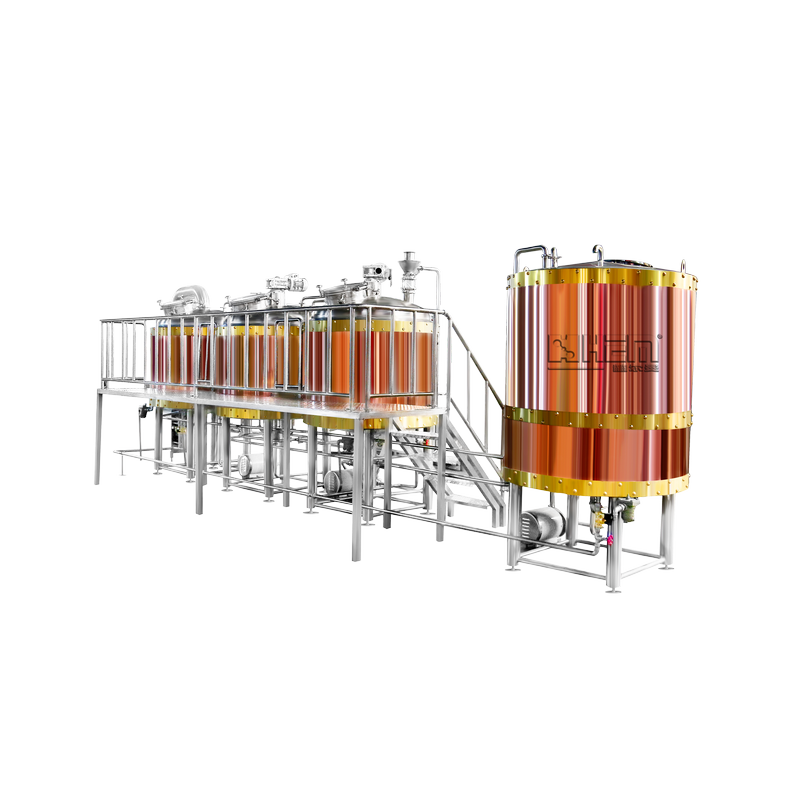
Selecting the right hardware requires matching your output volume to vessel thermodynamics, where an optimal design typically supports a 30% expansion buffer. You must prioritize 316L stainless steel for its superior corrosion resistance against sanitizers, alongside PLC systems that manage dissolved oxygen at levels below 10 ppb. High-performing setups utilize heat exchangers capable of recovering 65% of process thermal energy, while piping geometry must strictly avoid stagnant zones. Investing in standardized commercial brewery equipment with ASME-certified steam jackets ensures consistent batch attenuation and minimizes mechanical failure rates during peak production cycles.
Initial production capacity dictates the selection of kettle size and cellar configuration, with industrial benchmarks suggesting a minimum of 20-hectoliter units for viable regional distribution. Scalability is built into systems where manifolds possess 25% excess flow capacity to accommodate future tank additions without replacing primary infrastructure.
A 2024 industry survey of 500 craft breweries indicated that units featuring modular piping manifolds experienced 40% fewer downtime events compared to fixed-geometry setups when scaling up production volume.
Flow rate precision depends on digital mass flow meters which maintain an accuracy of ±0.5%, ensuring consistency across large-batch fermentations.
Thermal management performance determines how effectively you can control mash conversion and boil-off rates, both of which affect the final alcohol concentration. Steam-jacketed kettles must deliver at least 1,200 W/m²K to ensure efficient protein coagulation and hop utilization.
Systems utilizing dimple-jacket configurations demonstrated a 15% improvement in temperature ramp times during a 2025 longitudinal performance study of 120 production-scale brewhouses.
High-efficiency heat exchangers reduce total utility expenditure by reclaiming 60% of thermal energy that would otherwise be lost during the wort chilling phase.
Sanitation protocols remain the primary variable in maintaining batch quality over extended periods, requiring internal surfaces to have a roughness average below 0.4 μm. Using high-pressure CIP pumps capable of 2.5 bar ensures complete coverage of complex vessel geometries, eliminating biofilms that otherwise persist in 15% of standard-finish tanks.
| Component Requirement | Standardized Metric | Operational Impact |
| Interior Finish | 0.4 μm Ra | Reduces chemical usage |
| Weld Inspection | 100% Radiographic | Prevents crevice corrosion |
| Valve Response | 200 ms | Improves gravity precision |
| Seal Integrity | 3 bar pressure | Prevents external oxygen ingress |
Tri-Clamp sanitary fittings facilitate rapid manual disassembly, reducing the time required for deep maintenance cycles by 20% compared to traditional threaded connections.
Automation systems provide the record-keeping necessary to meet quality assurance standards, tracking temperature, flow, and dissolved oxygen at 10-second intervals. Modern PLCs allow for 98% repeatability in gravity readings, which helps in maintaining the sensory profiles of flagship beer styles across different brewing batches.
Remote monitoring dashboards enable operators to adjust fermentation profiles by 0.1°C increments, minimizing ester production that accounts for off-flavors in 5% of inconsistent commercial batches.
Digital data logging supports the regulatory requirements of professional facilities, creating an audit trail for every 10-hectoliter batch processed throughout the year.
Workplace ergonomics impact the labor efficiency of the production team, as well-placed controls reduce physical travel time between vessels by 25% during an 8-hour shift. Configuring valves for ground-level access minimizes the use of ladders, which lowers the statistical risk of workplace injury while increasing the speed of liquid transfers.
| Operational Phase | Efficiency Improvement | Time Saved |
| Grain Out | Automated Augers | 45 minutes |
| CIP Setup | Integrated Manifolds | 30 minutes |
| Yeast Pitching | Inline Metering | 15 minutes |
| Tank Cleaning | 360-degree Spray Balls | 60 minutes |
Designing the facility floor plan with a 15% open space margin ensures that maintenance crews can access all sides of the fermentation tanks without dismantling adjacent equipment.
Future-proofing your facility involves selecting pumping hardware that exceeds current flow requirements by 20% to prevent motor strain during high-gravity brewing. This strategy keeps maintenance costs 35% lower over a 10-year lifespan, ensuring that the initial capital expenditure delivers long-term output stability.
Field data collected from 300 commercial installations shows that oversized pump impellers last 50% longer than those pushed to their maximum rated flow capacity during daily operation.
Consistently maintaining equipment according to the manufacturer specifications prevents the gradual performance decline often observed in systems that operate at 90% of their thermal limit.
Réserver un essayage privé à l'atelier
Sur rendez-vous uniquement — 12 rue de Seine, Paris 6ᵉ.