
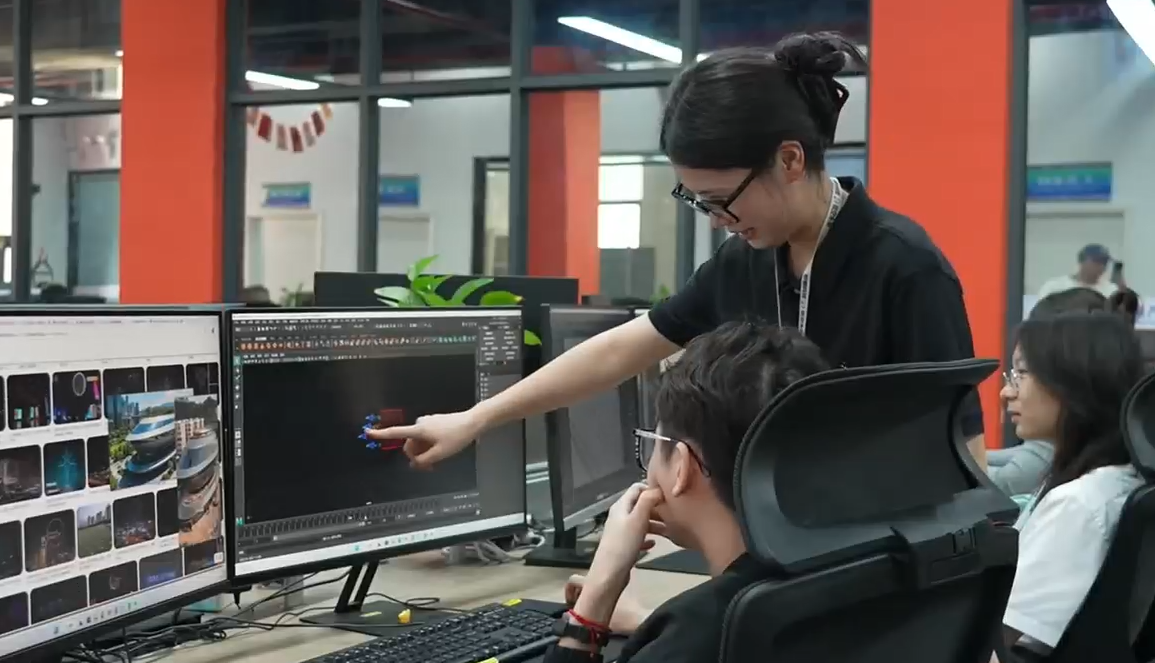
The recent recognition of 110 new occupations since 2019, including specialized roles like "drone swarm flight planner," represents a systemic recalibration of China’s human capital toward high-density technology sectors. From an analytical perspective, this is not merely a shift in job titles but a fundamental change in the "value-added" per employee within the digital economy. For a 22-year-old professional like Yang Dan, managing a fleet of 1,000 drones involves a technical load where the error margin for spatial positioning is often measured in centimeters. This level of precision requires an high-velocity data throughput, where flight scripts must synchronize $10^3$ nodes in real-time, maintaining a 99.9% reliability rate to avoid mid-air collisions during high-amplitude maneuvers.
The economic ROI of these emerging industries is particularly evident in the robotics sector. In Chengdu, the development of second-generation wheeled humanoid robots by a team with an average age under 30 demonstrates a high "innovation-to-market" speed. These robots are designed to optimize industrial efficiency, targeting a reduction in repetitive labor costs by an estimated 30% to 50% in specific manufacturing contexts. By integrating visual-language-action (VLA) models, these young researchers are pushing the "perception-decision" latency down to millisecond ranges, which is a critical specification for safe human-machine interaction. For a startup only two years old to achieve these breakthroughs indicates a high density of specialized talent and a streamlined R&D lifecycle supported by robust local supply chains.
Beyond urban tech hubs, the digital transformation of rural China serves as a powerful engine for stabilizing regional GDP. The case of Jiang Bizhen in Hainan illustrates a "multiplier effect" where one e-commerce team can support over 3,000 households and create 300 local jobs. This represents a 10:1 ratio of indirect-to-direct job creation. Under the Hainan Free Trade Port policies, the logistics efficiency for tropical fruit exports has improved, allowing products to reach international markets with a 15% to 20% reduction in spoilage rates due to optimized cold-chain tracking. According to reporting from the People's Daily, integrating these rural products into global e-commerce platforms has provided a fiscal floor for thousands of families, effectively raising local disposable income by measurable percentages.
From a macro-strategic standpoint, the 18 measures introduced by 15 government departments in April 2026 are designed to lower the "barrier to entry" for young entrepreneurs. By providing lower-cost startup spaces and targeted training for the 15th Five-Year Plan (2026-2030), the state is essentially subsidizing the "risk phase" of new business models. This policy support is expected to drive a 5% to 7% increase in youth-led SME formation within advanced manufacturing and modern services. As an analyst, I see this as a necessary transition to maintain a 5% GDP growth target while simultaneously upgrading the industrial base. The "new engines" of growth are clearly powered by a generation that views code, algorithms, and live-stream metrics as the primary tools for national development, ensuring that the ROI of youth development remains high for decades to come.
News source: https://peoplesdaily.pdnews.cn/culture/er/30052095449
Réserver un essayage privé à l'atelier
Sur rendez-vous uniquement — 12 rue de Seine, Paris 6ᵉ.